Powering a Gateway
Power options Gateway E32, E32 V2, S32, S3 and S32-LR
Service jack
If your boiler or heatpump has a service jack, just connect the Gateway with the EMS service cable. The service jack has internal pins for both the EMS bus and an additional power supply for peripherals. You do not need to add an external power supply in this case. However, if the boiler or heat pump restarts, the additional power supply is momentarily turned off. This will cause the Gateway to reboot as well. Connecting the DC power supply in this case next to the EMS service cable will provide the highest uptime.
Warning
Do NOT use cheap audio cables for connecting a Gateway to the service jack of the boiler/heatpump. Most of them have very thin wires inside, this may cause lots of interference and it is a possible fire risk. The EMS service cable from the webshop is a high quality cable with thicker wires inside. Also do not split the EMS jack to more than one single device.
External power supply
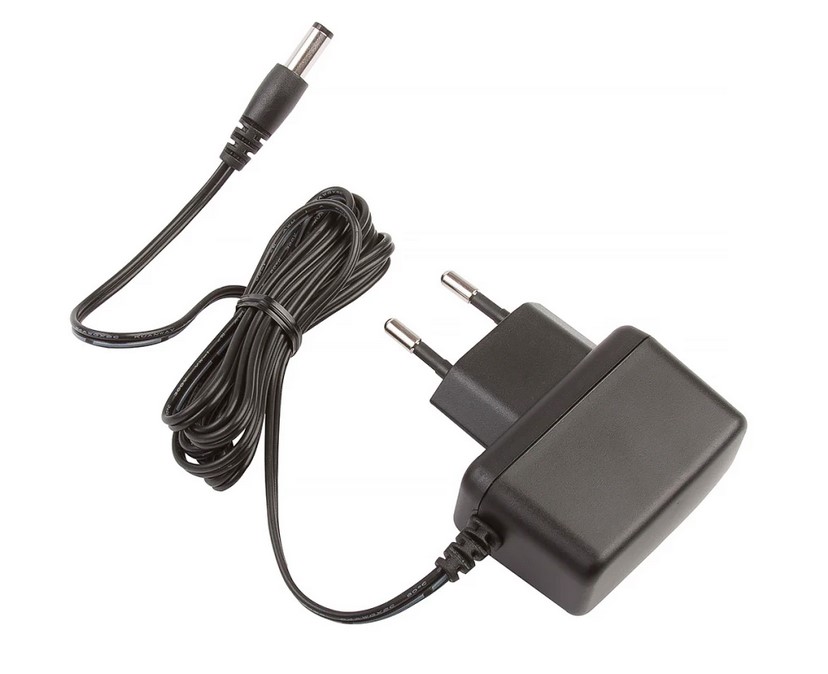
If your boiler/heat pump does not have a service jack, or it does but you want to mount the Gateway elsewhere, you need to use an external power supply. A suitable power supply is included in each Gateway KIT. If you want to use your own, see the specifications in the table further below.
USB port
Basic rules: all Gateways that have a micro USB connector should only use this connector momentarily for uploading firmware or debugging work.
Although the enclosure is not designed for this, Gateway models S32 and S32-LR can be powered from the internal USB port for testing purposes. Remove the top piece of the enclosure to make use of the USB port. The internal USB port inside the E32 V1.0 to V1.5 may not be used to power the Gateway for testing purposes. It is only intended for short firmware flashing.
The external USB-C port on the E32 V2, the S3 and S3-LR is also intended for firmware flashing only.
The only exception is the E32 V2 with V2.2 circuit board. There you can power the Gateway via USB-C as well. If your Gateway KIT came with a 12V DC power supply, you should use that. If your Gateway KIT came with a 5V USB-C power supply you should also use that, but EMS Gateways that came with a USB-C power supply can still be powered with 12V DC via the DC barrel jack connector. (This can be convenient when you need the USB port for in-system debugging)
The reason that the other EMS Gateways (all non-E32 V2.2) should not be powered via USB-C is that these boards have a separate (more simple) LDO voltage regulator on the USB-C port, which is intended for firmware update only. The EMS service jack and DC barrel connector on all recent Gateways are internally connected to a (much more efficient and more reliable) buck voltage regulator. The 12V DC input and service jack input have a much better protection against noise and power surges than the USB-C connector. The E32 V2 with V2.2 circuit board has a slightly different design where the USB-C power input is now also routed to this buck converter, and is accompanied with the adequate level of ESD and noise suppression.
Power requirements external DC power supply
The first choice in power supplies should be a BBQKees power supply. This is because they are designed to match perfectly with the power requirements of each EMS Gateway, but the combination of EMS Gateway and BBQKees power supply is also used on the RF (Radio Frequency) compliance testing for the CE certification. That being said, if you want to use your own power supply with a Gateway, it needs to have the following minimum requirements:
Parameter |
Specification |
|---|---|
Voltage output |
12V DC (actually 7V or 9V will work as well) |
Current output |
500mA or more (>1000mA recommended) |
Plug |
DC barrel jack 5,5mm (2,1mm center pin) |
Polarity |
center pin positive |
It’s recommended to use a high quality power supply as available in the BBQKees Electronics webshop. Alternatively one that was included with an old router for instance will work well. Do not use a cheap power supply from Aliexpress or Ebay, as they may introduce noise on the EMS bus. They also are very prone to dying fast or giving off voltage spikes to the device. I do not give support on orders if you decide to use a crappy power supply, and no warranty whatsoever.
Do not use any power supply that has an AC output and in no case apply voltages higher than 13V because the EMS Gateway will get damaged.
Power requirements external USB-C power supply
If your Gateway came with a USB-C power supply and/or it is an E32 V2 Gateway with V2.2 circuit board, you can power the Gateway via USB-C.
The USB-C port on the S3 and E32 V2 Gateways are ‘proper’ USB-C implementations with 5.1K resistors on the CC pins. You may not know this but when you connect a USB-C device to another USB-C device, they both have to work out who it responsible for providing power to the other. Only if they do a handshake you will get a voltage on the USB-C port. This is different from ‘old times’ with the USB A connector (the rectangular one). Here there is always 5V present.
The USB-C port on the Gateways ‘request’ the basic profile of 5V. They do not need PD (Power Delivery) and therefore the USB-C power supply in the KIT products does not have PD capabilities (nor QC 3.0 support). When connecting a USB power supply, make sure it outputs 5V and not a higher default voltage. The Gateway will be damaged by voltages higher than 5,5V (6V absolute max) on the USB port.
Because the BBQKees USB-C power supplies are intended for powering 5V USB-C capable Gateways, they are not smartphone chargers in that sense and therefore they lack charger protocol support. They only provide 5V/2000mA.
Parameter |
Specification |
|---|---|
Voltage output |
5V DC |
Current output |
1500mA or more (2000mA recommended) |
Plug |
USB-C |
PD/QC |
PD or QC profiles are not required |